

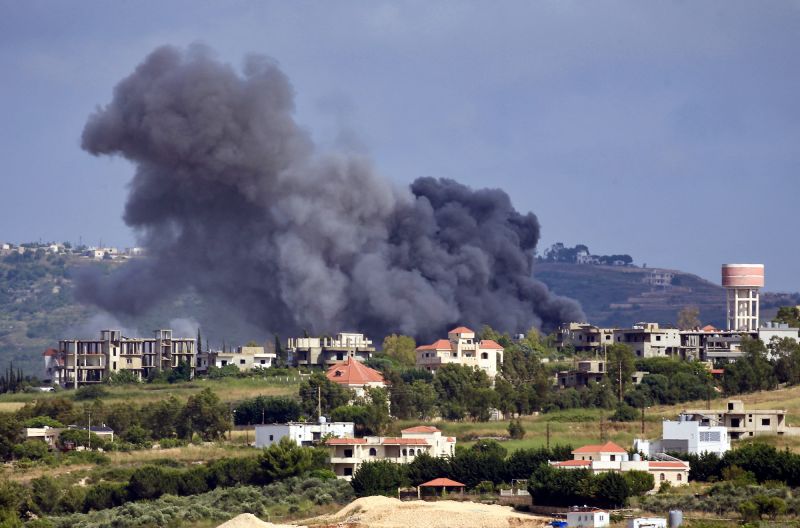
“We can plunge Lebanon completely into the dark and take apart Hezbollah’s power in days,” former Israeli war cabinet member Benny Gantz declared Tuesday at a conference at Reichman University in Herzliya, Israel.
It was just the latest threat from a prominent Israeli public figure against Lebanon and Hezbollah as tensions flare.
It won’t be difficult for Israel to plunge Lebanon into darkness. The country’s power grid, already crippled by decades of mismanagement and the country’s economic collapse, barely functions as it is. A few well-aimed airstrikes will easily finish it off.
Taking apart Hezbollah’s military power in days, however, is a far taller task.
Since its inconclusive 2006 war with the Lebanese militant group, Israel has been planning for a re-match.
Hezbollah too has long been preparing for war.
Its arsenal includes, according to Israeli estimates, at least 150,000 missiles and rockets. Israel estimates the group has already fired 5,000 since October, which means, as Hezbollah leader Hassan Nasrallah said in a speech last week, much of its arsenal remains intact.
These include systematic pinpoint strikes on Israel’s array of surveillance outposts along the border, shooting down high-flying top-of-the-line Israeli drones, and hits on Israel’s Iron Dome batteries and anti-drone defenses. Perhaps the biggest surprise for Israel, however, was the nine minutes of drone footage Hezbollah published online of highly sensitive civilian and military infrastructure in and around the northern city of Haifa.
Highly trained and disciplined
In addition to its weaponry, Hezbollah can probably field between 40,000 and 50,000 fighters – Nasrallah recently said more than 100,000. Many of these gained combat experience fighting alongside regime forces in the Syria civil war.
As a fighting force, Hezbollah is highly trained and disciplined, unlike many other guerrilla groups. During the 2006 war, in the experience of this correspondent, it was rare to encounter Hezbollah fighters. One day we came upon several of them in the ruins of a southern Lebanese village. They were polite but firm, devoid of boastful bluster and swagger, insisting we leave immediately for our own safety. They wouldn’t take no for an answer.
Unlike Gaza, Lebanon is not hemmed in by hostile neighbors. It has strategic depth, with friendly regimes in Syria and Iraq, allowing direct access to Iran.
Over the years Israel has regularly struck targets in Syria it believed were involved in trans-shipment of weapons to Hezbollah, but all indications are those strikes have been only partially successful.
In the event of war, full-scale war, both sides will be able to inflict significant pain on the other.
Fire and blood
Early this year the same Reichman University, where Gantz spoke, put out a report entitled “Fire and blood: The chilling reality facing Israel in a war with Hezbollah.” It laid out a grim scenario in which the Iranian-allied group would fire 2,500 to 3,000 rockets and missiles a day for weeks targeting Israeli military sites as well as densely populated cities in the center of the country. In the entire 34-day war of 2006 Hezbollah is estimated to have fired around 4,000 rockets – a daily average of 117.
It may not amount to mutually assured destruction a la Cold War, but enough destruction will be wreaked on Israel and Lebanon to make it costly for both.
At 6 a.m. on July 13, 2006 – less than 24 hours after the start of the war – Israeli warplanes bombed and knocked out Beirut’s Rafic Hariri International Airport. It’s widely expected that if war breaks out now the airport will be one of Israel’s targets. But unlike 2006, in 2024 Hezbollah may be able to hit Tel Aviv’s Ben Gurion International Airport.
In 2006, Haifa, Israel’s third largest city, was in range of Hezbollah’s missiles. This time those missiles are expected to reach much deeper into Israel.
Shifting strategic balance
Looking across the Middle East, the strategic balance that for so long favored Israel is changing.
Its foes are no longer corrupt and incompetent Arab regimes, but rather an array of non-state actors – from Hezbollah to Hamas to Islamic Jihad to the Houthis to militias in Iraq and Syria – in addition to Iran itself.
The Houthis in Yemen, once the epitome of a rag-tag tribal militia, are now, with Iran’s help, firing ballistic missiles toward Israel. The Houthis continue to target shipping in the Red Sea, despite the presence of a US-led armada off its shores.
The Iranian-backed militias in Iraq and Syria have largely held their fire since a series of US strikes in the aftermath of a drone attack killed three US soldiers in Jordan.
But that could change if Israel and Hezbollah go to war.
Recently Qais Al-Khazali, the leader of the powerful Iranian-backed Iraqi militia Asa’ib Ahl Al-Haq, warned that if the US supports an Israeli attack on Lebanon “then America should know that it will put all its interests in the region, particularly in Iraq, at risk and make them a target.”
Throwing caution to the wind
And then there’s Iran. Traditionally Tehran lets others fight its fights and stays in the background, but that changed in April when, in retaliation for the Israeli strike on its diplomatic complex in Damascus, Tehran responded with a volley of hundreds of missiles and drones toward Israel.
In the event Hezbollah, Iran’s premier regional ally, its crown jewel, is attacked by Israel, and indeed is “taken apart” by Israel as Gantz threatened, an Iranian response is likely.
It could merely instruct its allies to throw caution to the wind and fire at will at US interests and Israel. But then there’s this: Iran sits on the Strait of Hormuz, the entry point into the Persian Gulf. In the event of a major conflict, it has long been feared that Iran would block the strait, a move that would send world oil prices skyrocketing.
Since October, tensions on the Lebanon-Israel border have fluctuated. In the last few weeks, however, those tensions have escalated and war is looking ever more likely. The rhetoric on both sides is heating up. Germany, Sweden, Kuwait, the Netherlands and others are calling on their nationals to leave Lebanon immediately. If ever there was a danger of a regional war in the Middle East, that moment is now.